Thursday, 20 November 2014

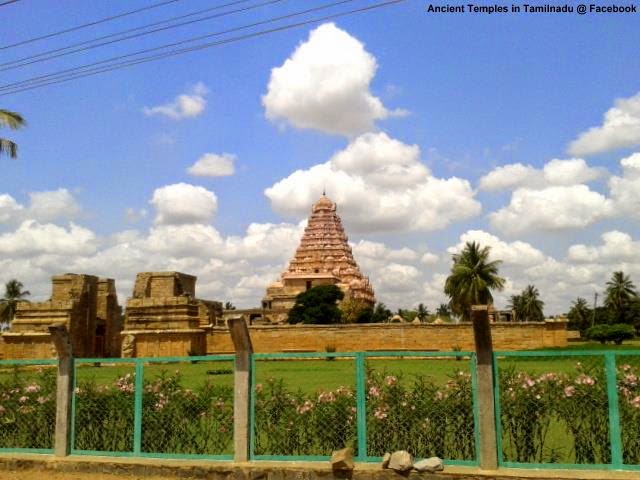
Gangaikonda Cholapuram - Bragadeeswarar Temple


Gangaikonda Cholapuram - Bragadeeswarar Temple


Moolavar : Bragadeeswarar 
Amman / Thayar : Periya Nayaki
Thala Virutcham : Pinnai, Vanni
Theertham : Simma Kinaru
Old year : 1000 years old


Temple's Speciality:

The Shiva Linga in the temple is the biggest in size among the Lingas in Tamilnadu temples. 

This is made of a single lime stone 200 metres far from the sanctum sanctorum and placed on ground. 

Sun light falls on the Nandhi each day reflecting on the Linga. 

Even if all lights in the sanctum are put off, devotees can see the Lord in the sunlight. 

This is an outstanding evidence of the rare skill of sculptors of Tamilnadu with no parallel elsewhere. 

The shadow of the Kalasa on the tower does not fall on ground. 

A rare stone called Chandrakanta stone is installed under the Linga which has a 
strange characteristic of making the sanctum sanctorum cool in summer and warm in winter. 

Mother Periya Nayaki, as Her very name suggests, is 9.5 feet tall standing majestically. 

The Navagrahas the nine planets are made of a single stone on Lotus design peeta. 

This is other rare individuality of the temple.


Greatness Of Temple:

The Shiva Linga in the temple is bigger than the one at Thanjavur temple. 
Thanjavur Linga is 12.5 feet tall on an Avudayar of a circumference of 55 feet.

The Linga in Gangaikonda Cholapuram temple is 13.5 feet tall placed on a Avudayar of 60 feet circumference. 

Planks are provided around the Linga to stand on to facilitate abishek pujas. 

It is also said that the Thanjavur Linga is masculine with pounding stone design (Ural in Tamil), the one in this temple is feminine in nature with Udukkai design.

The Nandhi the bull vehicle of Lord Shiva is also bigger than of Thanjavur. 

The Nandhi in Thanjavur is made of a single stone and placed on a high level mandap. 

The Nandhi in this temple is made of lime stone and placed on the ground. 

In Thanjavur, the Nandhi is 100 meters away from the sanctum, in this temple, the distance is 200 meters. 

Rays of Sun fall on the Nandhi each day and reflect on the Lord in the sanctum. 

The devotee can have a pleasant darshan of Lord even after putting off all lights, simply with sunlight. This is a rare sculptural skill exclusively of Tamilnadu.

A stone, called Chandrakanta stone is installed under the Linga with a rare power of making the place cool during summer and comforting warmth during winter. 

This is experienced by generations of priests of the temple. It appears that no temple has such an environment pleasure. 

Annabishekam is performed and celebrated in the temple on Aipasi full moon day by Sri Kanchi Kamakoti Peetam Mutt for quite a number of years. 

Hundreds of bags of rice are cooked for the purpose to cover this biggest Shiva Linga. 

This abishek begins at 9.00 a.m. on the day and continues till 4.00 p.m. 

More nivedhanas are offered to Lord prepared with vegetables and fruits. 

The Annabisheka Linga darshan is made available to the devotees from 6.00 p.m. to 9.00 p.m. 

As a tradition this Anna-rice is dissolved in rivers later. 

In this temple, the same is offered as Prasad taken from the Avudayar part of the Linga. 

The rice on the Linga is not offered as humans cannot bear its power, it is said. 

Those seeking child boon are particular to get the Prasad and consume it. 

Mother Periya Nayaki, as the very name suggest is tall and big in size. 

The devotee has to raise his/her head to worship the Mother to see Her merciful face. 

His Holiness Sri Chandrasekhara Saraswathi of Kanchi Kmakoti Peeth had installed a Sri Chakra at the feet of the Mother. 

People say that only after the installation of the Sri Chakra by Kanchi Seer, the crowd began to swell in the temple.

Navagrahas the nine planets are together on a lotus shaped peeta made of a single stone. 

The planets are around Sun on a Rath drawn by 7 horses. 

Aruna is the Sarathi-Rath driver. 

The mandap is so structured that devotees cannot circumambulate the Navagras, because they go round the world and humans should not go round them, according to one theory.

Mother Durga in the temple graces the devotees as a 9 year old pretty smiling little girl with 20 hands killing demon Mahishasura. 

She is the family deity of King Rajendra Chola. 

This is a rare form of Mother Durga praised as Mangala Chandi. 

People pray to her for wedding and child boons, employment and transfers to place of choice offering archanas. 

Rajendra Chola used to offer his worship first to Mother Durga and then only to Lord Shiva. 

Remembering this tradition, on Sundays devotees offer their first prayers in Durga Shrine before praying to Lord Shiva. 

Rajendra Chola called his Minister and demanded accounts for the temple construction. 

Minister was unable to submit the account correctly. 

He fell at the feet of Lord Vinayaka who restored his memory. Minister recollected the account as 8 thousand copper for Kavi (saffron) stones and 8 thousand copper for Kavi threads and so on. 

Hence, this Vinayaka was called Kanakku Vinayaka (accountant Vinayaka) presently praised as Lord Kanaka (Gold) Vinayaka. 

He appears with a pen (Ezhuthani in Tamil) in His right hand. 


The Rajagopuram of the temple is testimony to Chola temple architecture. 

As in Thanjavur, the tower was built only after installation of Lord. 

216 feet tall Tanjore Tower was built on a single base going up gradually in an even manner. 

The 180 feet tall tower in Gangaikonda Cholapuram temple has a base of 100 feet width up to 100 feet height. 

The base is reduced to 80 feet width after this level. 

The shadow of the tower does not fall in the ground. 

The Vimana-tower above the sanctum in the temple is the second biggest next to Thanjavur.

Temple History:
Rajendra Chola was born to King Rajaraja Chola and Queen Tribhuvana Madevi on the Margazhi Tiruvadhirai day. He was named Maduranthakan. 

He ruled from 1012 to 1044 AD. 

He conquered many countries crossing the sea including Kadaram and came to be known as Kadaram Kondan – Conqueror of Kadaram. 

He built a temple for Lord Shiva as his father did in Thanjavur and named the Lord and Mother, Bragadeeswarar and Periyanayaki as in the first temple. 
He brought the abishek water from Ganga for consecration carried by kings defeated by him. 
Hence the name of the place, Gangai Konda Chola Puram.
Rajendra dug a well in the temple and made the abishek water fall in the well. 
He also made a Lion statue, the symbol of the Chola dynasty and placed it on the well. 
While visiting the temple, he will spill this water on his head before worshipping the Lord. 
The whole temple is built with rocks. 
The Shiva Linga is biggest in Tamilnadu. 
Dhotis and upper cloth are specially woven for the Lord to cover the size.
Chandikeswara in the temple is all powerful.


Follow this excellent Facebook page - https://www.facebook.com/ancienttemplesintamilnadu


*****


Monday, 17 November 2014

Pyramids of the Vedic Civilization

SOME SAY PYRAMIDS AROUND THE WORLD WERE MADE WHEN WORLD WAS VEDIC CIVILIZATION WITH CONTROL AT MT.KAILASH PYRAMID. 


===========================================
|| LET'S SEE FOR THE GREAT PYRAMID OF EGYPT ||
===========================================
The geometrical analysis of the ‘Great Pyramids’ at Giza (Egypt) shows that the base area of a pyramid divided by twelve times its height equals the universal mathematical constant π (pi). The ratio of its vertical and horizontal edges is 1.618…, which is an important geometrical constant φ (phi). This perfection of mathematical formulae in its design can’t be a mere coincidence. It is also a puzzling surprise that its depth below the earth’s surface is exactly the same as its heights above the surface.

A billion times of the height of a Great Pyramid equals the astronomical unit (the sun-earth distance). It is also remarkable that the solar energy-radiations are found to be significantly dense on the earth at this distance at the inclination at which the pyramids are located. 

The north-south axis (diagonal) in the middle of the pyramid divides the earth in two equal parts; not only that, this division also halves the land and the water on the earth. These and similar findings affirm that the architects of the pyramids had accurate knowledge of the geometry of the earth and the solar system and they had made use of it for advanced level experiments and applications through these pyramid shaped laboratories.

The wonders of pyramids include the fact that these are situated right above the geo-center of the gravitational field. The total of diagonal lengths of a Great Pyramid is about ten-thousandth fraction of the radius of the earth. The original meter, which was defined as one ten millionth of the distance between North Pole and the Equator, is one-fortieth of its edge. It appears that the pyramids were also used for certain standards of scale. If we multiply the number of days 365) in a non-leap year by 100 and add the number of hours (=24) in one day (the extra day of the leap year!), we get 36524. This happens to be the value (in meters) of the total peripheral surface of a Great Pyramid! 

The entrances of all the pyramids happen to face the East. Moreover their central axes at the entrance are directed towards the point in ecliptic reached by the sun at solstice (on the 21st June and 22nd December, when the sun is farthest from the equator and appears to pause before the earth returns nearer). These findings suggest astrological / astronomical applications of the pyramids.

Historical studies mention of an Egyptian Archaeo-architect and Priest named Imhotep, who had prepared the calendar of the year 4229 B.C.; it is amazing to note that his calendar also showed 365 days in a year. Such precision of calculations was also reflected in other information given in his calendar; this could be possible only by substantial knowledge of the movements of the planets and stars in and around our solar system. Usually very few planet/stars are seen in the sky over Cairo (Egypt), that too not so clearly as could be visible from other parts of the world. Then, what kinds of telescopes were used for astronomical studies those days? Were the pyramids serving as the observatories? This was also the common belief of the Arabs. However, the scientific authenticity of this possibility got accepted only after publication of the book "The Great Pyramid – Observatory, Tomb and Temple" by British Astronomer, Richard Anthony Procter in the late nineteenth century.

The learned author has revealed many important facts on applications of pyramids in planetary studies in the above book. According to him, the location of pyramids on the Equator is along the north-south geo-axis from where positions and movements of the planets and stars on the North Pole side could have been studied by the astrologers of ancient Egypt. The canals beneath the base of the pyramids lie straight in the direction of the Pole Star; the deviation angles of its rays could be measured here. These canals are dug beneath the earth’s surface at an angle of 26 degrees and 17 minutes, which happens to be the angle of reflection of light there. The upward and downward directions of these canals are according to the angles of incidence and reflection of light. These dark wells of 200 ft deep canals thus illustrate the thorough knowledge of astronomy by the experts of those days.

The above are some notable facts on the construction of the pyramids. The atmosphere inside the pyramids is found more astonishing and has posed many challenges before the modern scientists. Nobel Laureate Luis Alvarez had tried to measure the energy levels inside the pyramids using a cosmic counter machine but he did not succeed, as his instrument stopped working in the energized fields here. Surprisingly, it happened during several trials; the instrument would start functioning fine as soon as it was brought out beyond a certain distance from the pyramids. 

X-raying the pyramids by groups of scientists coupled with the studies by renowned physicists like Dr. A. Goneid showed findings inside the pyramids that were beyond explanation by scientific laws. Dr. M. Mc Luhan of Ontario, Canada and several others have also researched on these aspects and found that somewhat different forms of energy-fields than the electromagnetic energy (which is the energy so far known, pervading in the space) seem to exist inside the pyramids.

In view of these arcane energy fields of high intensity found inside the pyramids, the researchers opine that such marvelous scientific structures can’t be graveyards. These must have been built for some super-level purposes such as astronomic studies, understanding of the cosmos, experiments on subliminal energy, and/or spiritual modes of devotion, etc. Many believe that the rare cosmic energy indwelling here could induce sublime transmutation. This view is strongly supported by Manly P. Hall in his celebrated work entitled "The Secret Teachings of All Ages" (first ed. 1928). He mentions that staying inside the pyramids used to empower the devotees with evolved spiritual energy. In his view, pyramids might have been constructed as spiritual energy centers for enlightened transformation of personality.

Historical reviews also indicate that as per the period of their construction, the pyramids do not appear to be originally constructed as the graveyards of the Pharaoh Kings of Egypt; neither their construction took place during the reigns of the latter. 

In his research dissertation on "The Pyramids of Egypt", published in 1964, I. E. S. Edwards has shown 3100 B. C. to 332 B. C. as the period of the rule of the Pharaohs in Egypt. Till the early 20th Century AD, the pyramids were also largely believed to have been erected during this period. However, advanced archeological studies and scientific analysis have shown that the pyramids are much older. 

British archeologist, Walter Emory had examined the stones of the Great Pyramids of Giza using spectrographs and had estimated the age of these constructions to be between eleven thousand to fifteen thousand years. 

The Bodleian Library at Oxford has an antique treatise of Egypt, which is written on Birch Leaves. Abu Al Massoudi describes the pyramids as constructed prior to the disastrous inundation that had engulfed most parts of the earth and gave rise to its present form. 

As most of the modern historians approve the occurrence of this epochal flood disaster to be before 15000 years, the age of the pyramids is found to be older than fifteen thousand years from historical proofs as well. 

Similar supporting evidences of the recent times affirm that the great pyramids of Egypt were not built during the reign of the Pharaohs. Arabic researcher Abu Jed Al Balkhi has estimated the age of these pyramids as about thirty-three thousand years based on the results of Carbon-14 techniques applied to the organic remains of the later ages in these monuments.

It is important here to note the recent findings of distinguished anthropologist and archaeologist Prof. Tom Dillehay and Dr Dennis Stanford on the prehistoric global migration. 


They have thoroughly analyzed the archaeological data, the antique structures, data from excavated sites and the skulls, bones and soil/stone constructs obtained there, data on linguistic and geographic history and the data on anthropological research and evolutionary studies in genetics. Their research has annulled the hypothesis that Asians had migrated to America via the Bay of Bering about ten thousands years ago. Based on the results of this research, Prof. Tom Dillehay of the Archaeology Dept., Kentucky University (USA) concludes that – there are proofs of human inhabitation in Chile since about 33,000 years; the migration of Asians towards the American continent had begun much before that. 

He also argues that even the frozen strait of Bering could not hinder this migration. According to Dr. Dennis Stanford of the Smithsonian Institute (USA) this prehistoric migration had taken place in three to four stages. The findings of these researchers also support what was written by Abu Al Massoudi and point out that the architects of The Great Pyramids were not the ancient Egyptians, rather some others who had reached there much before the advent of Egyptian or Greek civilization.

Who were these "others" who had constructed the pyramids? The observations of Bill Schultz and Ed Petit are worth noting in this context. In their book "The Secret Powers of Pyramids" the authors cite that the fame of ancient Greeks as the founders of Mathematics is there just because they were able to decipher some knowledge from a well developed science of much more older civilization. 

The classical Alexandria of Greeks could gather and propagate only a fraction of the gigantic knowledge available with the handful of great sages, the unknown migrants, who had reached the land of Egypt thousands of years before the dawn of Greek civilization. These strangers (migrants from some more ancient and advanced civilization) of yore –– the founders of trigonometry, geometry, archaeology and astronomy – were the architects of the pyramids in the views of the authors.
The above findings and the studies of ancient Indian Culture indicate that the great sagacious migrants believed to be the architects of The Great Pyramids were the Indian rishis (the seers, sages and scientists of Vedic Age), who possessed supramental talents and had realized the supreme knowledge. 

Many of their disciples had migrated in small groups to even the farthest corners of the globe to spread the light of this supreme knowledge and sow the seeds of human civilization there. That the rishis possessed immense knowledge of the sciences pertaining to matter and the gross manifestation of Nature along with their expertise in spirituality and yoga – is clearly reflected in several treatises of the Vedic Literature. 

The following slokas from the 352nd Chapter of the "Matsya Puran" cite the names of eighteen experts of archaeo-architecture and civil engineering of the Vedic Age: 

Bhraguratrirvasistha Ca Visvakarma Mayastatha |
Narado Nagnajiccaiva Visalaksah Purandarah ||

Brahmakumaro Nandisah Saunako Garg Eva Ca |
Vasudevoaniruddhasca Tatha Sukrabraahaspati ||

Astadasaite Vikhyata Vastusastropadesakah |
Sanksepanopadistam Yanmanve Matsyarupina ||

Of these eighteen, Vishwakarma and Maya were regarded as the leading masters. These two are referred respectively as the architects for the devatas (manifestations of divine powers) and for the danavas (demonic giants). The magical buildings, cities and supernatural instruments devised by them are cited in the Vedic Literature and also in the later scriptures like Mahabharata and Ramayana. 

That these were not mere mythological depictions has been authentically investigated by the researchers of the modern times as well. 

It was certainly an easy task for such geniuses to construct the monumental pyramids. Archaeological and historical research up till now has shown that the Maya civilization in ancient Mexico was an offshoot of the Maya civilization in ancient India. The ‘Inca’ civilization spread from Ecuador to Peru was also a branch of this civilization cultivated by Maya and his followers. All these evidences strengthen the findings of Prof. Dillehay and Dr. Bill Schultz et al and show that the Great Pyramids are also an illustration of the advanced architectural knowledge of the Vedic India and that the great Indian architects of that time had constructed these wonders of the world.

What the historical data mark as the time period when the Shulbsutra and Brahmsutra were written now appears to be a little before the time the pyramids were built. These two post-vedic Indian scriptures happen to be the fundamental source of knowledge (derived from the Vedas) on vastukala (architecture), which also encompasses the secrets of constructions for archaeo-astronomical and ethno-astrological studies and hidden specificities of vastu-designs for spiritual impact, etc. This further leads to the conclusion that the ancient Indians had masterminded the magnificent design and amazing properties of The Great Pyramids.
Another puzzle associated with the pyramids is the purpose and mode of their use. The history of investigations on their mystery has also been very interesting. Many anecdotes were popular in the first few centuries A. D. about the tragic deaths of some explorers who tried to dig out the facts inside. 

The first authentic record in the history mentions of Khalifa Harun Al Rashid’s adventurous son Abdullah Al Memmon’s attempt in the year 820 A. D. Abdullah went inside the pyramids with a group of some intrepid young men carrying heavy hammers and chisels. Their efforts of removing or breaking some stones were ruined in the void, as the stones and their joints were too stout for the tools. In another attempt, concentrated acid was used to make a big hole from where some of the investigators could enter inside the gigantic tombs. But, they could find nothing – not a single corpse or mummy, no royal belongings. It took them about a month to come out from that labyrinth. Material needed for Mummification like Cinnamon was imported from India.

The common belief of these being the graveyards for preservation of the mummies was shattered completely when a team of investigators of international repute declared after search operations for several months that there were no mummies, no coffins and no hidden treasures inside the pyramids or in their basements. 

It is quite probable that in some period of the Egyptian rule, these might have been used for this purpose, as the energy fields inside were found to be miraculous. Most likely, this hypothesis also might have been just imaginary or an offshoot of false notions created to enhance the glory of the Pharaohs. Whatever it be, the possibility of such majestic designs with astonishing scientific and astronomical features having been constructed for merely keeping dead bodies does not appear logical in any respect; it is also not supported by any of the authentic research studies.

The unique energy fields found here indicate that these pyramids were made and used for higher-level meditations, devotional practices and spiritual experiments. These appear to be serving as reservoirs of cosmic radiation for such experiments.

Journalist and philosopher, Paul Brunton had spent a night in a pyramid of Giza. His observations were compiled in the book (published by Rider & Co., 1935) entitled "A Search in Secret Egypt" where he mentions of experiencing the presence of divine consciousness-force inside these ‘celestial’ laboratories.

Several scientific experiments conducted inside the pyramids illustrate the presence of an exceptional energy field. Among these, the experiment of Austrian scientist Vern Cameron has been very popular. He had kept a watermelon inside a bathroom type wet chamber in the pyramid. Surprisingly, despite having water inside and around, the watermelon had shrunk into a tiny dry-fruit of the size of a chestnut with splendid taste. 


This amazing result inspired the scientist to study the aura of energy there. For this, he first worked with spectrographic recording of the energy domains (of light radiations, thermal and electromagnetic energy currents, etc) inside pyramid shaped designs in his lab. The aura of energy had an inverted pyramid shape and showed concentration of superimposed energy waves towards the base-center. The field remained dense at the particular spot for long time even after the model designs were taken away.

Another widely publicized experiment was conducted in the late twentieth century by some Russian scientists. A pot containing a six inches long fresh sapling of a plant having two or three leaves was kept inside a glass pyramid. The response and growth pattern of this tiny plant was recorded continuously by time-lapse video camera. The plant appeared to be dancing on a sonorous tune. It first inclined slightly towards the floor. Then took a round towards the east; from there it completed the round by moving towards the west. Having reached the west, it became straight and started oscillating in a slow rhythm. It repeated this ‘dance’ for few minutes at an interval of two hours. Surprisingly, no such movements were seen in any of the saplings (of same age) of that plant in the pots kept outside the pyramid.

Another interesting observation was that only the sapling inside the pyramid showed its greed (like the humans!) for the precious metal by bending completely towards a piece of gold which was placed near it.

The rishis – the ancient Indian experts of geometry, architecture and other sciences and the deep science of cosmic energy – were well aware of the distinct features of pyramid shaped designs. They had also chosen the specific positions on the equator for the construction of the gigantic pyramids at Giza (Egypt), for maximum attraction and conservation of rare cosmic radiations there. They were the torchbearers of divine light, who might have used these pyramids as centres of sublime spiritual endeavors. The savants of today, sitting on the peaks of modern marvelous scientific advancement, may well begin to reinvestigate the noble use of the pyramids for similar experiments.


Source & References:
1. Pt. Shriram Sharma Acharya: Samasta Vishwa Ko Bharat Ke Ajastra Anudan."Pt. Shriram Sharma Acharya Vangmaya", Vol. 35. Published by Akhand Jyoti Sansthan, Mathura:283001 (U.P., India). 1995.
2. Dr. Kapil Dwivedi: Vedon Mein Vigyan. Published by Vishwa Bharti Anusandhan Parishad, Gyanpur, Bhadohi (U.P., India). 2000

Monday, 3 November 2014

SECRET OF GANGA WATER AND BACTERIOPHAGE THERAPY


SECRET OF GANGA WATER AND BACTERIOPHAGE THERAPY

=====Mysterious Power of Ganga Water=====
There are two major factors which give Ganges its unique ability.
1. The presence of ‪#‎Bacteriophages‬ which gives it the anti-bacterial nature.
2. An unknown factor called the Mystery Factor, which gives this river an unusual ability to retain dissolved oxygen from the atmosphere!
=====Antibacterial Nature of Ganges Water=====
In 1896, E. Hanbury Hankin (a British physician) after testing the water of Ganga wrote in a paper published in the French journal Annales de IInstitut Pasteur ,
The bacterium Vibrio Cholerae which causes the deadly Cholera disease, when put into the waters of ‪#‎Ganga‬ died within three hours! The same bacteria continued to thrive in distilled water even after 48 hours!
He also suggested that the water of this river and its tributary Yamuna were responsible for containing the spread of this deadly disease cholera in the region in those days!!
====Water of Ganges has Anti-putrefaction properties====
C.E. Nelson, another British physician noticed that, the waters of Ganga when taken even from one of its dirtiest mouths at Hooghly, by the ships returning to England, remained fresh throughout the long journey!! Normally river water begins to putrefy over a period of time due to lack of oxygen which promotes the growth of anaerobic bacteria, which in turn gives rise to the smell of stale water.
====How River Ganga cleans the dead bodies=====
In 1927, Flix dHerelle , a French microbiologist, was amazed when he saw that only a few feet below the bodies of persons floating in the Ganga who had died of dysentery and cholera, where one would expect millions of germs, there were no germs at all!
In other words, Hindus had for thousands of years rightly believed that Ganga purifies the dead bodies, which is why probably the bodies of even those who died of infectious diseases were offered to this river for purification!
<<<<<Recent Research on Ganges>>>>
D.S. Bhargava, an Indian environmental engineer/professor of ‪#‎hydrology‬has spent a life time studying the amazing properties of Ganges. He measured the remarkable self cleansing ability of Ganges in an exhaustive three year study which showed that Ganges is able to reduce its biochemical oxygen demand levels much faster than other rivers! Bhargava says that the self-purifying quality of this river leads to oxygen levels that are 25 times higher than any other river in the world.The Ganges cleans up suspended wastes 15 to 20 times faster when compared to other rivers!
In a study conducted by the ‪#‎Malaria‬ Research Center in New Delhi it was observes that the water from the upper reaches of Ganga did not host mosquito breeding, and also prevented mosquito breeding in any water it was added to! On the other hand, water from other rivers were shown to allow mosquito breeding!
=====Bacteriophage in Ganga Water
Bacteriophage are those viruses which kill bacteria. What a cat is to a mouse, the bacteriophage is to a bacterium. In fact what Hankin reported in 1896 about the antibacterial nature of Ganges was the first modern observation/documentation of a Bacteriophage ! It was Herelle, (who again observed the anti-bacterial nature of Ganges) who coined the term Bacteriophage (meaning bacteria eater ) for these viruses.
The high levels of oxygen in the waters of Ganga gives it the unique ability to remain fresh over a prolonged period of time. The waters of Ganga when added to other water resources in adequate amount, causes the bacteriophage in it to quickly multiply cleaning the new water resource of any bacteria present in it. Which is why the ancient Indians used to take Ganga jal back home to clean their local water resources! People practice it even today, except that most of them dont know the actual reason!
In other words, the water of river Ganga can be an alternative for using antibiotics to treat bacterial diseases! Ancient Indians who used the water of rivers like Ganga never required any antibiotics, for the very water they used was anti-bacterial in nature! This type of Bacteriophage Therapy has been suggested by many researchers, but rarely tried/tested or practised in the health industry.
In fact it was in the former Soviet Union that the most active research about using bacteriophages to treat bacterial diseases was done at the George Eliava Institute ! This research institute was co-founded by George Eliava and Felix DHerelle after DHerelle introduced Eliava to the wonderful world of Bacteriophages.
====End of antibiotics?
Today more and more bacteria are becoming resistant to ‪#‎antibiotics‬. The world is running out of antibiotics! We need an alternative, and a potential alternative is Bacteriophage therapy.
The emergence of pathogenic bacteria resistant to most, if not all, currently available antimicrobial agents has become a critical problem in modern medicine, particularly because of the concomitant increase in immunosuppressed patients. The concern that humankind is reentering the preantibiotics era has become very real, and the development of alternative antiinfection modalities has become one of the highest priorities of modern medicine and biotechnology. - Source Phage International
<<<<<Phage Therapy Research in India>>>>>
GangaGen Biotechnologies , a bio-medical research company based out of Bangalore, is now leading the alternative therapy of Bacteriophage based treatment for antibiotic resistant bacteria. It is the first firm to have developed bacteriophage based commercial products. Their first bacteriophage based product was to treat the problem of E.Coli in Cattle.
====Industrial Pollution in the waters of Ganga
Having said all this, all along the course of river Ganga, today 27 major towns dump over 900 million litres of sewage/industrial waste into it every day! This nonsense should be stopped at any cost. Humans have no rights to pollute the natural resources of this planet. If we cant handle our waste, we shouldn’t be producing it in the first place. Rather than being an individual’s symbolic effort to fight pollution, it should be an enlightened mass movement of entire humanity to create non-polluting technology out of the science we know.
The very fact that almost all the technology that we possess today in the name of development and modernization is polluting, proves that the technology we have created using modern science is still primitive. It has more to do with our greed, than with science.
As Mahatma Gandhi once said, Earth Provides enough to satisfy every man’s need but not every man’s greed.
=================================================
River Ganga/Ganges with its source in the mighty ‪#‎Himalayan‬ mountains is considered to be the most sacred river by Hindus. The waters of Ganga (referred to as Ganga jal) is believed to be self cleansing in nature and it is said that a single dip in the waters of this holy river will wash away all the sins of a person!
The last rites of the thousands of Hindus are performed at the numerous ghats along the shores of Ganga at the holy sites like Kashi, Varanasi etc. Thousands of human bodies are consigned to this holy river. Millions of Hindus take bath in the waters of this river day in and out and millions more in a single day during festival seasons throughout the year. And yet there is no sign of contagious diseases spreading from person to person due to contact through this river water! Nor is there any sign of things like skin disorders etc after bathing in this river!
A river which is 2525 kilometers long, which has been the lifeline of the entire stretch of the Ganga-Yamuna plains, with over 300 million dependents today
UnlikeThe Western world is yet to understand the power of our Mantras and we are doing all we can to forget it too. The Mantras have energizing capabilities that alters the bio-memories of everything. Water retains the memory of its environment and when these mantras are chanted with its purity and intensity, the water retains and nourishes its positivity. What do you think happens during Kumbha Mela?

Thursday, 9 October 2014

5,000-year-old Harappan stepwell found in Kutch, bigger than Mohenjodaro's

5,000-year-old Harappan stepwell found in Kutch, bigger than Mohenjodaro's


5,000-year-old Harappan stepwell found in Kutch, bigger than Mohenjodaro's
The stepwell that was found during the excavation by ASI in Dholavira, Kutch.
AHMEDABAD: A 5,000-year-old stepwell has been found in one of the largest Harappan cities, Dholavira, in Kutch, which is three times bigger than the Great Bath at Mohenjo Daro.

Located in the eastern reservoir of Dholavira by experts from the Archaeological Survey of India working with IIT-Gandhinagar, the site represents the largest, grandest, and the best furnished ancient reservoir discovered so far in the country.

It's rectangular and 73.4m long, 29.3m wide, and 10m deep. Another site, the ornate Rani ki Vav in Patan, called the queen of stepwells, is already on Unesco list.

"This is almost three times bigger than the Great Bath of Mohenjo Daro that's 12m in length, 7m in width, and 2.4m in depth," said V N Prabhakar, visiting faculty at IIT and superintending archaeologist, ASI.

"We will conduct spot analysis in December as various surveys have indicated other reservoirs and stepwells may be buried in Dholavira," Prabhakar told TOI.

"We also suspect a huge lake and an ancient shoreline are buried in the archaeological site that's one of the five largest Harappan sites and the most prominent archaeological site in India belonging to the Indus Valley civilization," he added.

Experts will investigate the advanced hydraulic engineering used by Harappans for building the stepwell through 3D laser scanner, remote sensing technology and ground-penetrating radar system.


"We will study how water flowed into the well and what was the idea behind water conservation," said Prabhakar. The IIT Gandhinagar team and ASI officials will also excavate various tanks, stoneware, finely furnished brick blocks, sanitation chambers and semi-precious stones hidden at the site.

Precious stones like carnelian were in great demand during the Harappan era. Gujarat was the hub of bead and craft manufacturing industries. "Agate carnelian beads were also coveted," Prabhakar said.

Siddharth Rai and V Vinod of IIT-Gn are working on characterization of internal structures of various forms of pottery unearthed from the site to identify the diet followed by Harappans. "Through pottery typology, we'll find out whether different communities lived in Dholavira," Rai said. The team will also analyze precious copper and bronze artefacts.

http://timesofindia.indiatimes.com/india/5000-year-old-Harappan-stepwell-found-in-Kutch-bigger-than-Mohenjodaros/articleshow/44638220.cms?

Tuesday, 16 September 2014

Ganesha in Japan


KANGITEN (Elephant-Headed Deity known as Ganesha in Hinduism)


Image : Kangiten Statue near entrance to Fukuoka Tower 20 minutes from Nishi-Arashi Station.

In Japan, Ganesha is also known generally by three names: Binyakaten, the generic appellation Binayaka meaning Vinayaka, Shoten (Aryadeca) and Kangiten. His other names are Ganabachi or Ganapati and Ganwha (Ganesha). The third epithet Kangiten applies to a unique type of Ganesa evolved in China and Japan known as the double (two-paired). Kangiten is a god of happiness; or joy who brings prosperity and promotes well-being. Thus, the Japanese Ganesa, like the Indian prototype, is both a vighnakarta, obstacle creator and vighnaharta, obstacle remover, in his tantric form he radiates happiness, joy.

Kangiten, ( Lord Ganesha) is worshipped as a central object of devotion. Kangiten symbolizes conjugal affection, and is thus prayed to by couples hoping for children. Statues of this deity are relatively rare in Japan -- most are kept hidden from public view and used in secretive rituals of the Tendai and Shingon sects of Esoteric Buddhism.


he Vedic Gods of Japan

Dr Subhash Kak

The Vedas tell us that the gods (deva in Sanskrit) reside within the mind. But since physical reality is also experienced as a construction of the mind, therefore, one may see the Vedic gods in the physical space and its relationships. These conceptions led to the detailed exposition of the devas in yoga, tantra as well as in architecture and iconography.

The Vedic way recognizes that reality is a synthesis of opposites. We are suspended between being and becoming, between hazy memories of the past and fears for the future. Within each of us lie not only sublime thoughts but also avarice and greed. We are the battlefield of a struggle between the gods and demons. The opposites require an act of balance so that the individual’s relationship to Truth is articulated only partly by means of abstract ideas, and it needs art – in performance and representation – to complete the picture. The two poles of the approach to reality are provided by the Upanishadic mahāvākyas: “I am Brahman” or “I am the Universe” (aham brahmāsmi) and “Not this, not this” (neti, neti). These lead to two artistic styles: one rich and textured, the other spare and austere. One speaks of infinite possibility and structure (Brahman), the other of nothingness (shunyata). Each of these is the ground of the other; within one lays the other in endless recursive details. This is the essence of the paradox taught in the Vedas to help one learn that one is not a thing, but a process. On the one hand are the maddeningly complex rituals, on the other the simplicity of dhyāna (meditation). Both these styles are to be incorporated within the life process.

The Western philological approach to the Vedas not only misses this understanding of the Vedas, it has misguided generations of scholars and laypersons into a simplistic view of Indian culture. It sees Hinduism and Buddhism in dichotomous terms that appear absurd to those within the tradition. The Buddha himself affirmed on the basis of his own direct experience the existence of the various elements of the Vedic world view, including the existence of many hells, heavens, and various supernatural beings like devas, asuras (demons), and rāk¬asas. The Buddha claimed to have seen these realms and beings with his divine sight, and he also claimed to have observed how sentient beings cycle through these diverse forms of existence in the interminable process of transmigration. The Buddha, therefore, took for granted the Vedic cosmic geography wherein all these natural and supernatural beings lived. It is no wonder then that the anthology Subhasitaratnakosa of Vidyakara (c. 1100) a Buddhist abbot at the monastery of Jagaddala in present-day Bangladesh, has 20 verses to the Buddha, but 73 to Shiva, and 40 to Vishnu.

The philologists and the anthropologists wonder what Shiva and Vishnu are doing in a book by a Buddhist. Neither can they explain how the Vedic devas continue to be a part of the Mahayana pantheon. Their texts absurdly describe the Vedic devas of Japan and China as
Buddhist since according to legend they became followers of the Buddha when he started preaching. The Buddha in the Mahayana tradition is the principle of Understanding, who fits in perfectly within the Vedic conception, and we see this most emphatically in the Lotus Sutra (Saddharma Pundarika Sutra).

Living in an isolated valley, Kashmiris have maintained many old customs, although their recent tragic history has been responsible for much loss of the meaning of their ceremonies. For example, we were told of six psychological states of the existence, where the lowest three states represented (1) ideas of evil people, (2) ghosts of unfulfilled desires, and (3) our animal nature. The highest three states are (4) asuras, who take the bodies to be all that we are; (5) humans; and (6) devas, who embody the essence of the various tattvas (or their combinations) that constitutes the world of the mind. There were ceremonies in which the yak¬as were invoked. We didn’t quite understand these ceremonies although we were reminded of their connection to architecture and directions by their appearance in the ruins at Avantipur and Martanda.  The Vedic devas went to China and Japan through Kashmir. The fourth great council was held there under the patronage of the Kushana emperor Kanishka (r. 78-120) in around 100 CE, where monks of the Sarvastivadin School compiled a new canon. This became the basis of Mahayana. The Vedic devas were a part of this understanding, as was dhyana of the Vedic tradition (Ch’an in China and Zen in Japan) with devotion to Ishvara (Shiva) as its ultimate objective (Yogasutra 1.23). The Parihasapura monuments (near Srinagar) of the Chankuna stupa (Karkota dynasty, 8th century) “served as a model all across Asia from the Pamir Mountains to Japan”.

The Kashmiri images of the Vedic devas were also much copied. The art historian Susan Huntington reminds us: “The Yunkang caves in China, the wall paintings from several sites in Inner Asia, especially Qizil and Tun-huang, the paintings from the cache at Tun-huang, and some iconographic manuscripts from Japan, for example, should be evaluated with Kashmir in mind as a possible source.” Vedic ideas were also taken to Japan by the sea route from South India and Southeast Asia. That serves to explain the specific transformations of some Sanskrit terms into Japanese through Tamil phonology. For example, consider the transformation of Sanskrit homa, the Vedic fire rite, into Japanese goma, where the initiation is given by the Achari (Sanskrit Acharya). The Sanskrit mantras in Japan are written the Siddham script of South India.

In this article, I present the main Vedic gods that are popular in present-day Japan. I begin with the Vedic fire and consecration ceremonies and then describe the gods of the directions and a few goddesses.

Goma-Homa

Homa, Vedic fire rite, remains central to religion in Japan. It consists of mantra, mudra, and mandala. In the Vedic fire-ritual manuals, some instructions regarding mudra are given. For example, the ladles are to be held in the Shankha-mudra, and when the priest enters the chamber, he is to put his right palm downward on his left palm at right angles and close the hands. The fire-ritual is the quintessential Vedic ritual, emphasizing the process of transformation.The artistic parallels of this ritual is presented most clearly by Kapila Vatsyayan.

Abhisheka

Another Vedic rite that is widely practiced is abhisheka (consecration). The initiates are given a potion to drink before they enter the room. Inside, the initiate places the right foot on an elephant, which represents Ganesha or Vinayaka, (Kangitan in Japanese) as he is the remover of obstacles. Next, the initiates rub powdered incense on their hands, and dab it on their foreheads and also on their tongues, and then swallow the potion.  Now the candidate enters the first room, where the samaya vow (sammaya-kai) – the vow of secrecy -- is administered. They hear hymns being chanted as they are given instructions as to the meaning of the rite by the priest. Another image of Ganesha is seen surrounded by offerings.

Two mandalas are used in the ceremonies: the Garbhadhatu (womb mandala) and the Vajradhatu (diamond mandala). The candidates are first initiated into the garbhadhatu; the following day they are initiated into the vajradhatu. The candidates are each blindfolded with a strip, white for the womb mandala, red for the vajra mandala. A folded paper flower, white or red depending on the mandala, is put between their joined hands, with their fingers slightly crossed at the end, and then they are led in front of the mandala in a central room.
The candidate goes through a landscape-screened labyrinth of the oblong buildings (corresponding to the Vedic goddess temple), to its centre, the womb, (the garbhagrha section of the Indian temple), where the mandala is located. The squares of the mandala corresponding to the deities are left blank, with white circles. A homa fire is burning in the chamber.

The candidate now is given a flower to throw at the mandala. The circle on which it lands becomes the candidate's tutelary deity for life, and this is whispered into his ear by the master. Now the blindfold is taken off and the candidate is taken to a side table. A crown is placed on his head, showing his initiation. Water from a well has been drawn in advance with special mantras to make it symbolic of the five oceans. Now the master pours five drops of it on the crown of the candidateand consecrates him as a monarch, cakravartin, of dharma. Next the master takes a bronze needle (Shalaka in Sanskrit) and applies it to his eye, saying “the scales of ignorance have fallen from your eyes; your eyes are open.” Then he takes a bronze mirror and holds it up to the newly initiated master (no longer a candidate), for him to see his face.

This is the illumination just as it is done in inaugurating a new mūrti or a new icon, when the mirror is held up to the icon so that the first gaze of the newly consecrated icon is caught in the mirror and reflected back at the icon. As the icon animates itself, the newly enlightened master is enlightened by himself. The new master has become an acharya (and he can ordain or initiate others. He can perform rituals which increase in strength and power, and above all he can call upon his tutelary deity at any time. He has entered the mandala. He did not just go into the room, but actually became part of the mandala. He has become a living deva.

The devas are called tenbu (or merely ten, when used as a suffix after the deva name). There are a large number of devas, depending on how you count them. One may consider them as capacities of the mind, as attributes, or as projections in space and time.

Guardians of All Directions

As guardians of directions, the devas are often listed as a group of twelve that includes the lordship of the four quarters and four semi-quarters (the eight dikpalas, given below as by Amarsiha in Amarakośa), up and down and the sun and moon. The last four may also be considered as the three divisions of the world: the earth, the moon (for atmosphere), the sun (for sky), and the transcending Brahman (who may be taken to represent heaven). Representations of the Twelve Devas were made in 1127 C.E. to be hung at the annual, New Year’s ceremony of esoteric prayers, held at Shingon-in, in the Imperial Palace in Kyoto and are now in the Kyoto National Museum.

Spiritual States

In addition to the devas (the highest expression of the tattvas) are other spiritual states that represent other mixed states of being. According to the Lotus Sūtra, they may be viewed as part of the human nature in the sequence: Deva, Garuda, Yaksha, Gandharva, Kinnara, Asura, Naga, Mahoraga, where the spectrum ranges from the celestial to the terrestrial. There is an opposition at the ends, such as between Deva and Mahoraga (great attachment); Garuda and Naga; Yaksha and Asura; and Gandharva and Kinnara. These eight classes are called the Hachibushu in Japanese.  Tenbu (Skt: Deva) The devas (Indra is their chief) reside in heaven. These 33 gods of the Vedas control the world of desire. Above them is the Heaven of Brahma (the spiritual world pure of desire), including the Four Heavens of Meditation in the Realm of Form and the Fourfold Realm of Formlessness. The devas are also known as the Suras (those having the ambrosia).

Ryu (Skt: Naga).

Serpent-like creatures, these are spirits associated with water. They control rivers, lakes and seas, and they dwell deep in the ocean. They represent the instinctive forces of nature.

Yasha (Skt: Yaksha), guardian of directions and wealth. Originally asuras from the earth, the Yakshas were later accepted by the devas. They are guardians of the earth’s treasures and protectors of the gates and moats of their king Kubera.

Kendatsuba (Skt: Gandharva). They are celestial musicians to Indra and husbands of apsaras. Dhatarashtra (Protector of the Nation - the Strong) is their lord. They are erotic and are the patrons of marriageable girls.

Ashura (Skt: Asura). Demons, enemies of the devas and Indra, with whom they are forever at war. They are the aspects of our nature that take the body to be the sole self. They thrive on ambition, anger and jealousy. They represent our personal demons.

Karura (Skt: Garuda) It is the enemy and devourer of serpents (Nagas). It is the vehicle of Vishnu and it carries the wish-fulfilling (Chintamani) gem around its neck.

Kinnara (Skt: Kinnara).  They have the heads of men and bodies of birds or horses. They are also musicians like the Gandharvas.

Magoraka (Skt: Mahoraga). He embodies uncontrolled attachment, and depicted as a monstrous snake. He is ‘human but not human.’

Mahakala (Daikokuten)

Mahakala is Time incarnate, who is either Death or the divinity who helps one deal with potential disaster and death (like Yama for Nachiketa in Katha Upanishad). Thus Daikokuten as Mahakala is the patron god of farmers and peasants. He is identified with the Shinto figure Okuninushi no Mikoto. In western Japan, Daikoku is identified with the protection of the ricefields and worshiped as the god of agriculture. On his chest he has a golden sun disk and in his hand he holds a magic mallet (with male and female symbols) which fulfils all wishes. His familiar is the rat, and he is a friend of children.

Kichijoten or  Kisshouten (Lakshmi)

Lakshmi is the consort of Vishnu and is the goddess of fortune. The goddess of luck and of beauty, she is the patroness of song and dance, and protectress of the geishas. She is the sister of the war god Bishamon.

Benzaiten (Sarasvati)

She is the goddess of knowledge, patroness of music, and the fine arts (dancing, acting, visual). In India she carries the vina, and in Japan she carries the biwa (a short-necked lute that is related to the Chinese pipa). Sarasvati is also the River Goddess and so her shrines are almost invariably in the neighborhood of water -- the sea, a river, or a pond.

The Twelve Yakshas (Juni-shinsho)

The Yakshas are the warriors in the service of the guardian of wealth, the deva Kubera, and they are also the guardians of treasury and gardens.

Conclusions

The Vedic devas are the creative forces of the spirit that help the individual connect with the Self. The Japanese religion, through its practices of the homa, abhisheka, and dhyana, has maintained continuity with the original revelation. A more vital connection with the
Vedas would lead to a discovery of new insights related to the central role of the devas in transformation and transcendence in the arts of Asia.